
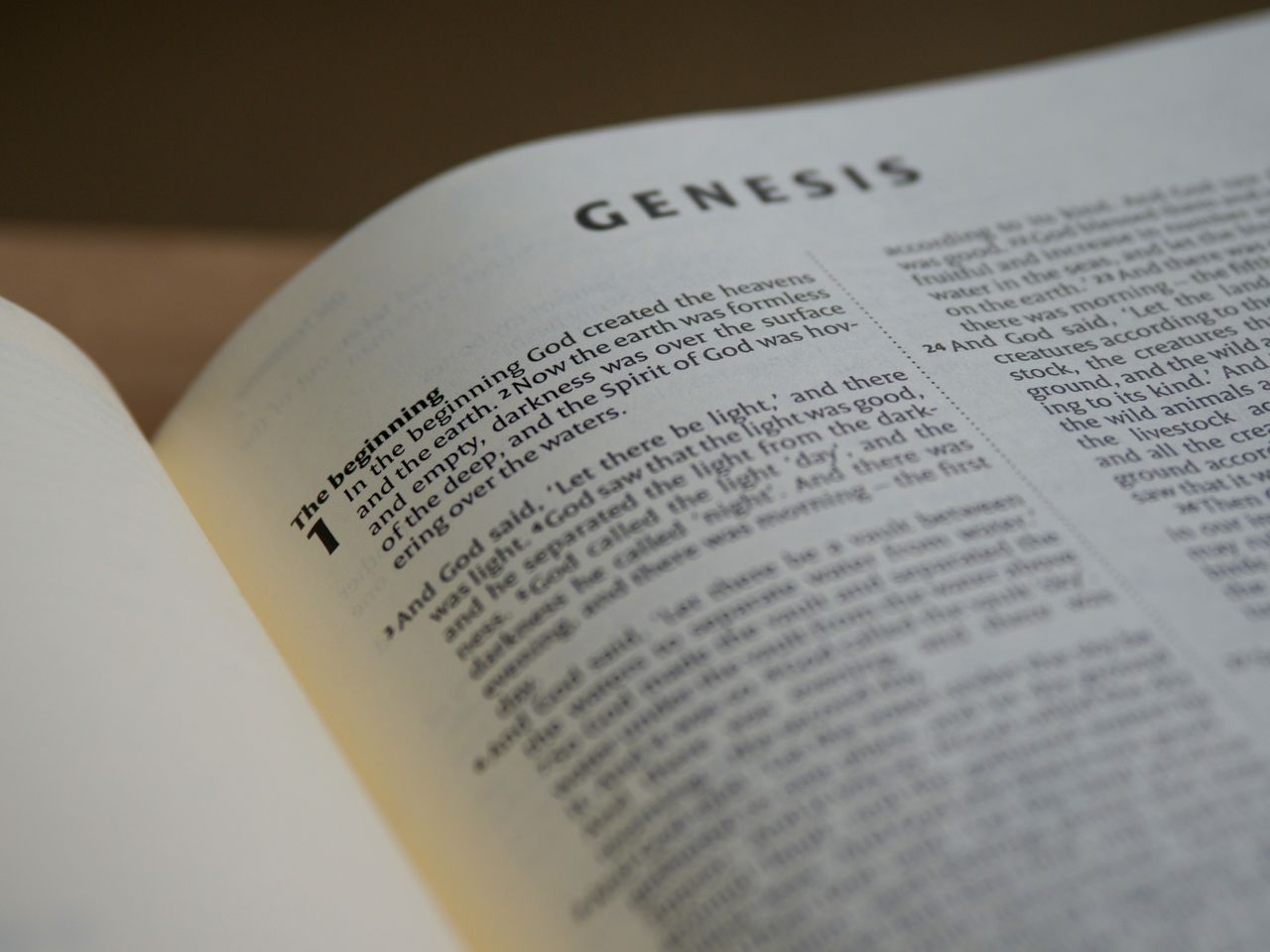
Arguments about the identity of Yeshua often begin with a completed theological system and then return to the biblical texts to show how the pieces fit.
This study will proceed in the opposite direction.
We will begin with the Jewish Scriptures and the Jewish interpretive world from which the earliest claims about Yeshua emerged. We will then ask what John’s language actually requires.
Where the Trinitarian reading is strong, I will present it strongly. Where a Biblical Unitarian reading offers an alternative, it must explain the same evidence rather than simply appeal to “agency,” “representation,” or “foreordination” whenever a difficult text appears.
The central question is simple:
Did Yeshua personally and consciously exist as a divine individual before his human birth, or did God’s Word, wisdom, purpose, glory and foreknowledge precede him until that divine purpose became flesh in the historical Messiah?
My proposal is that God created with Messiah in view. His effective Word carries His wisdom and purpose into creation; Yeshua is the human Messiah in whom that Word becomes flesh and the intended heir through whom others receive their inheritance.
This study begins where John begins: בְּרֵאשִׁית Bereshit “In the beginning.”
The Nazarene Restoration
I call the interpretive approach used in this study the Nazarene Restoration. It is the theological direction of the Bright Branch Assembly and Making a Path Straight.
By “Nazarene” I am not claiming an unbroken institutional succession from a particular ancient sect. I am describing the direction of restoration: back toward the Jewish, Israel-centered, Torah-conscious world of Yeshua and the earliest apostles, before later Christian systems became the controlling framework through which their language was read.
This matters because Biblical Unitarianism by itself does not guarantee biblical continuity. A person may reject the Trinity while remaining deeply antinomian, replacement-theological, dismissive of Israel, or even hostile toward Jewish people and Jewish modes of reading Scripture. That is not the restoration pursued here.
The Nazarene Restoration begins with Israel’s God, Israel’s Scriptures, Israel’s Messiah, and Israel’s covenant story. Gentiles are welcomed into that story through Messiah; they do not replace it. Our aim is therefore not merely to recover a non-Trinitarian Christology, but to recover a Jewish-Christian way of understanding Yeshua that preserves the continuity of the God, Scriptures, promises and covenant world from which the Gospel emerged.
The Strongest Case for Trinitarian Christology
Classical Trinitarianism does not teach that the Father, Son and Holy Spirit are three independent gods. It teaches that the one God eternally exists as three distinct persons who share the one divine being. Within that framework, the Son is not a later creature or merely an exalted human being. He is the eternal divine Logos who was with God and was God, through whom all things were created, and who became genuinely human without ceasing to be divine.
The biblical case for this doctrine is cumulative. Its advocates point to John’s declaration that the Word was God, that all things came into being through him, and that the Word became flesh; Yeshua’s language about descending from heaven, existing before Abraham, and possessing glory with the Father before the world existed; and Thomas addressing him as “my Lord and my God.” They also appeal to Paul’s inclusion of Yeshua within the confession of the one God and one Lord in 1 Corinthians 8:6, the language of divine form and universal homage in Philippians 2:6–11, the Son’s relation to creation in Colossians 1:15–17, and Hebrews’ application of Creator-language to the Son. Revelation’s portrayal of the Lamb receiving heavenly honor and the New Testament’s application of passages concerning YHWH to Yeshua are understood as further evidence that he participates in the unique divine identity.
Trinitarian theology then interprets Yeshua’s humanity, dependence, temptation, limited knowledge, obedience and death through the incarnation. The eternal Son assumed a complete human nature and therefore experienced genuine human limitation while remaining divine. His submission to the Father is understood in relation to his incarnate mission and human nature, not as evidence that the Son possesses an inferior divine nature.
This is the strongest form of the argument that I can present. It does not rest upon one isolated verse, nor is it answered merely by observing that Yeshua prayed, obeyed, suffered or died. Any serious alternative must explain why the cumulative evidence has been read this way and then show that another framework accounts for the same passages more naturally within the scriptural world of Israel.
Can the Trinity Doctrine be Tested?
Classical Trinitarianism is not literally unfalsifiable. In principle, evidence could count against it. The difficulty arises when the completed doctrinal system itself becomes the rule by which every biblical statement must be interpreted.
The framework explains Yeshua’s ignorance, temptation and death through his humanity, and his received authority and subordination through his incarnate mission. None of those distinctions is logically impossible. The question is whether the individual texts themselves require them.
If every apparently human datum is assigned to the human nature, every apparently divine datum to the divine nature, every statement of subordination to the economy, and every statement of equality to ontology, the system becomes extremely resistant to disconfirmation. The doctrine explains the texts, and then the texts are cited as evidence for the doctrine.
This study therefore asks an earlier question: What does each text require before the later harmonizing framework is supplied?
The Biblical Unitarian model must submit to the same standard. As mentioned; “Agency,” “foreordination,” and “representation” cannot become escape hatches by which every difficult passage is automatically explained away. If a passage actually requires conscious personal pre-existence, identifies Yeshua ontologically with YHWH, or presents him as intrinsic Creator rather than commissioned agent, that evidence must be allowed to count against the model.
Before John: Creation as the Expression of God
Genesis does not portray creation as raw power erupting without intelligence or purpose. Elohim speaks, distinguishes, names, orders, assigns boundaries, blesses, and repeatedly declares what He has made to be good. Creation proceeds according to intention.
Scripture later describes that creative activity explicitly in terms of God’s Word:
“By the word of the Lord the heavens were made, and all their host by the breath of his mouth.” Psalm 33:6 (RSV)
“For he spoke, and it came to be; he commanded, and it stood forth.” Psalm 33:9 (RSV)
God’s Word is His effective self-expression. It carries what He knows, chooses, values, orders, promises and intends, and accomplishes what He sends it to do. Through His Word, God gives effect to His wisdom and makes His character known.
Isaiah uses the same kind of language:
“so shall my word be that goes forth from my mouth; it shall not return to me empty, but it shall accomplish that which I purpose, and prosper in the thing for which I sent it.” Isa 55:11 (RSV)
Notice the movement. The Word is God’s. It proceeds from Him. It expresses His desire. It accomplishes His purpose.
Israel’s Scriptures speak similarly of divine Wisdom:
“The Lord by wisdom founded the earth; by understanding he established the heavens;” Proverbs 3:19
Proverbs 8:22–31 develops this much further by personifying Wisdom as present during the ordering of creation. The poetry speaks of Wisdom almost as though she were a living companion, yet the personification itself does not establish that Wisdom is an autonomous divine person. What it clearly demonstrates is that Israel’s Scriptures could speak vividly and personally about God’s own Wisdom as active in creation.
Word and Wisdom therefore belong together within the biblical picture. They express the Creator’s mind, intention, order and purpose becoming effective in what He makes.
Creation consequently expresses its Creator without being identical to its Creator. The regularities according to which matter behaves, the mathematical order of nature, the capacity of chemistry to form stable complexity, and the extraordinary diversity and interdependence of life reveal a universe characterized by profound order rather than arbitrary chaos. Science describes those regularities; Scripture interprets the created order theologically as the product of divine wisdom, intention and command.
In biblical language, creation conforms to the Creator’s Word because creation is the realization of His intention. Nothing in these passages by itself requires us to identify that effective Word as a second conscious divine subject alongside God.
This gives us the Jewish-scriptural framework within which John’s opening claim must first be investigated:
“In the beginning was the Word, and the Word was with God, and the Word was God.” John 1:1 (RSV)
John is not introducing the idea of God having a Word or Wisdom for the first time. Israel’s Scriptures already speak of YHWH creating by His Word and founding the world by His Wisdom.
The question is therefore more precise:
What kind of existence does John attribute to that Word, and what does he mean when he eventually says that the Word became flesh?
The Hebrew Text: Alef and Taw in Genesis 1
John’s “In the beginning” directs the reader back to Genesis. My proposal is that he also interprets a feature of its Hebrew wording: the recurring אֵת, Alef–Taw, alongside God’s activity concerning creation, light, living creatures and humanity. John unfolds the theological significance of this pattern through the Word, life and light, culminating in Yeshua. On this reading, Logos expresses what John perceives within the Hebrew creation account; it is not a dictionary translation of אֵת. To follow the argument, we must first distinguish the particle’s grammatical function from the significance I propose John draws from its written form and placement.
Genesis 1:1 reads:
בְּרֵאשִׁית בָּרָא אֱלֹהִים אֵת הַשָּׁמַיִם וְאֵת הָאָרֶץ
Bereshit bara Elohim ’et ha-shamayim ve’et ha-aretz.
“In the beginning God created (’et) the heavens and (’et) the earth.”
The little word אֵת ’et normally disappears completely in English.
That is not a conspiracy, mistranslation, or theological omission. Grammatically, אֵת is a Hebrew marker placed before a definite direct object. It tells the reader, in effect, “Here is the particular thing receiving the action.” It normally contributes no separate English word of its own.
Imagine English worked this way: “The boy kicked ET the ball.” ET would not mean “ball,” “kick,” “everything,” or “A to Z.” It would simply mark the ball as the definite object being kicked. That is the peshat: the ordinary grammatical level, and nothing in this study requires us to deny it. Jewish interpretation has long recognized that a text can operate at more than one level.
Later Jewish terminology summarizes these as:
-Peshat (plain sense)
-Remez (hint or allusion)
-Derash (interpretive exposition)
-Sod (deeper or hidden sense)
I am not claiming that John consciously followed a later PaRDeS formula. I am using these familiar categories descriptively to distinguish grammar from legitimate literary and theological reflection.
But Hebrew readers can see something an English reader cannot. אֵת is written with two letters:
א — Alef, the first letter of the Hebrew Alefbet.
ת — Taw, the last letter of the Hebrew Alefbet.
To a child learning English, the easiest comparison would be A–Z. If someone said, “I searched from A to Z,” we would understand the image: from the first letter to the last, and therefore everything between them.
Hebrew אֵת does not grammatically mean “A to Z.” But its visible spelling places the first and last letters of the Alefbet together. That makes a symbolic Alef-to-Taw reading possible without changing its ordinary grammatical function.
And Scripture itself gives us a reason to take first-and-last imagery seriously. Yehovah declares:
“I am the first and I am the last; besides me there is no god.” Isaiah 44:6 (RSV)
Again:
“I am He, I am the first, and I am the last.” Isaiah 48:12 (RSV)
Centuries later Revelation expresses the same kind of totality alphabetically:
“I am the Alpha and the Omega.” Revelation 1:8 (RSV)
Alpha and Omega are simply the first and last letters of the Greek alphabet, the Greek equivalent of saying “A to Z.” Revelation 1:8 explicitly places this declaration on the lips of “the Lord God … the Almighty.” Greek Bible
Isaiah does not call אֵת a divine name, and Revelation is not translating Hebrew אֵת. Those claims would go beyond the text. The point is narrower and stronger: Scripture itself uses first-to-last language, including first-and-last-letter imagery, to express divine completeness and supremacy.
That makes the otherwise ordinary written form א–ת worth noticing.
Here is how it reads:
v1 bara Elohim ET ha-shamayim. Literally: “God created ET-the heavens and w-ET-the earth”
v4 way-yar Elohim ET ha-owr. Literally: “God saw ET-the light…”
v7 “…God made ET-the firmament…”
v16 “…God made ET-the great lights…”
v21 “…God created ET-the living creatures…”
v25 “…God made ET-the beast, ET-the livestock, ET-every crawling thing…”
v27 “…God created ET-the man…”
Across these passages, אֵת repeatedly appears between Elohim’s action and the definite object of that action: the heavens and earth, the light, the firmament, the luminaries, living creatures and humanity. Its grammatical role explains its placement. My proposal concerns the theological significance John perceives in the recurring written pattern as he brings creation, life, light and humanity together in his Prologue.
Why Does This Disappear in Translation?
The symbolism depends upon Hebrew spelling, and grammar does not transfer from one language to another word for word.
The Greek Septuagint renders Genesis 1:1:
Ἐν ἀρχῇ ἐποίησεν ὁ θεὸς τὸν οὐρανὸν καὶ τὴν γῆν
“In the beginning God made the heaven and the earth.”
Greek does not need a separate equivalent of Hebrew אֵת here. Its grammatical case system identifies the objects. The Alef–Taw therefore simply disappears. Latin likewise uses its own grammatical system. Amusingly, Latin has a word spelled et, but Latin et means “and” and has nothing whatsoever to do with Hebrew אֵת. English likewise has no corresponding object marker, so translators correctly write simply “the heavens and the earth.”
Aramaic comes closer. Targum Onkelos reads:
בְּקַדְמִין בְּרָא יְיָ יָת שְׁמַיָּא וְיָת אַרְעָא
bə-qadmin bara YHWH yat shemayya we-yat ar‘a
“In the beginning the LORD created the heavens and the earth.”
Aramaic uses יָת yat as a direct-object marker in precisely these positions. It preserves the grammatical function but not the Alef–Taw spelling: Hebrew א–ת has become Aramaic י–ת.
Syriac, an Eastern Aramaic language, normally uses other mechanisms for direct objects and does not regularly preserve yat in this function. So the disappearance of Alef–Taw outside Hebrew is exactly what we should expect. The grammatical function can be carried into another language, but the visual relationship between Alef and Taw, the first and last letters of the Hebrew Alefbet, cannot simply travel with it.
This matters because both Jewish and Gentile communities increasingly encountered Israel’s Scriptures through languages other than Hebrew. They could preserve the meaning of the sentence while losing a feature visible on the Hebrew page. Nothing had to be deliberately removed; the feature simply did not survive the change of language.
The result is that a Hebrew-centered literary observation can become almost invisible to later readers. Part of the Nazarene Restoration attempted here is therefore not to invent a new meaning for אֵת, but to put the Hebrew text back in front of John’s Greek Prologue and ask whether something visible to a Hebrew reader helps explain the way John rereads Genesis.
The distinction I will maintain throughout this study is simple:
Peshat: אֵת is the definite-direct-object marker.
Remez: its written form is Alef + Taw, first + last, and can suggest totality or completeness.
Derash proposal: John interprets the recurring Alef–Taw pattern in Hebrew Genesis through his presentation of the Logos, gathering creation, life, light and humanity into one account of God’s self-expression.
Christological synthesis: the divine Word and messianic purpose present with God from the beginning become flesh in Yeshua, who makes the unseen God known.
These levels should not be confused. The latter three are interpretations built upon the Hebrew text; they are not alternative dictionary definitions of אֵת.
Before asking what later Christianity said John meant, read John through the Jewish Scriptures and Jewish interpretive world that existed before him. When we do that, John 1 looks much less like the invention of a divine second person and much more like an extraordinary Jewish midrash on Genesis 1.
The question is not whether Messiah was ‘before’ his birth in some sense. Scripture plainly speaks of realities existing beforehand in God’s knowledge, purpose, promise, glory, and decree. The question is whether John requires us to believe that Yeshua personally and consciously lived as a divine individual before his human birth.
“…chose us in him before the foundation of the world…” Ephesians 1:4 (RSV)
“…of his own purpose and the grace which he gave us in Christ Jesus ages ago…” 2 Timothy 1:9 (RSV)
“He was destined before the foundation of the world but was made manifest at the end of the times for your sake.” 1 Peter 1:20 (RSV)
The apostolic pattern is: known beforehand → purposed beforehand → revealed afterward.
Jewish Ways of Speaking About the Word
The Hebrew Scriptures have now given us the basic categories: God creates through His Word and Wisdom, and Genesis itself contains a first-to-last Alef–Taw pattern that becomes largely invisible outside Hebrew. The next question is historical. How did Jewish interpreters speak about God’s Word, Wisdom and creative activity as these Scriptures moved into Greek and Aramaic intellectual worlds?
The evidence is not uniform. Some traditions speak of God’s Word in strongly active or personified language without clearly making it another divine person. Others, especially in Hellenistic philosophical settings, move much further toward an intermediary figure. These differences matter because they show that words such as Logos and Memra did not carry one fixed ontology. They had to be interpreted within their own Jewish and historical contexts.
Philo and the Greek Reframing of the Logos
This helps explain why Jewish thinkers interacting with Greek philosophy could reach for the language of Logos.
Philo of Alexandria was not writing in a conceptual vacuum. He was a Jewish interpreter deeply engaged with Greek philosophical categories, especially Platonic, Pythagorean and Stoic thought. Modern scholarship explicitly recognizes this interaction, and Philo’s Logos can function as God’s image, instrument of creation, “firstborn,” deputy, and intermediary.
Philo’s basic philosophical problem is understandable:
How does the utterly transcendent God produce an ordered world? What mediates intention and actuality, invisible wisdom and visible creation?
His answer increasingly gives the divine Logos an intermediary and at times strongly personified role.
One of the earliest mentions of the Logos being considered a form of intermediary is attributed to Philo (c.30-40ce):
“If someone wished to use plainer terms, he would say that the world apprehended by the intellect is nothing other than the Logos of God [Logos; translated as Reason] as God is already engaged in creating the world. For the city apprehended by the intellect is likewise nothing other than the architect’s reasoning as he is already contemplating the construction of the city.” Philo, On the Creation of the World §24.
Another:
“the second God, who is His Logos” Philo, Questions and Answers on Genesis 2.62
Philo matters here because he demonstrates how questions concerning God’s oneness, transcendence and creative activity could be reopened when Israel’s Scriptures were interpreted through Greek metaphysical categories. His surviving work therefore gives us firsthand evidence of a particular Alexandrian synthesis, not a consensus statement from the earlier Hebrew Scriptures or from Jewish interpreters generally.
Under this philosophical pressure, God’s own Logos could be described not merely as His spoken command or wisdom, but as image, instrument, intermediary, firstborn and even “second God.” These expressions show how Greek metaphysical distinctions could gradually transform the terms of the discussion. The question is not whether Philo remained committed to the God of Israel. He plainly did. The question is what happened to the interpretation of that God when biblical language was reorganized through philosophical categories not supplied by the Hebrew text itself.
Philo’s language must be examined within his own interpretation of Scripture. Neither its philosophical sophistication nor the pressures surrounding Jewish life establish that it expresses Israel’s original understanding of God’s Word. His Logos does not demonstrate that divine plurality belonged to the established faith of Israel. It shows a Hellenistic interpreter pushing Israel’s language about God into a new and disputed category. To take Philo’s exceptional Alexandrian synthesis, call it ordinary Jewish thought, use it to interpret John, and then project it backward into Genesis reverses the direction of the evidence. It turns a contested reinterpretation into an imaginary original doctrine.
This is precisely where the Nazarene Restoration parts company with Philo. The divine Word need not be an autonomous second being standing alongside Yehovah. It can be understood as Yehovah’s own wisdom, determination and effective self-expression: His invisible intention becoming ordered reality.
Philo is therefore valuable not because he proves that John inherited his system, but because he makes the interpretive division visible. Greek metaphysics moves the Logos toward a distinct intermediary between God and creation. The Hebrew-scriptural framework allows God’s Word to remain what it had always been: God’s own wisdom, will and effective action, ultimately embodied in the human Messiah.
Word Language in Aramaic and Syriac
The distinction between translation and interpretation is essential here. I am not proposing that translators rendered אֵת as Logos, Memra or Miltha. I am proposing that John uses Logos to unfold the divine self-expression he perceives in Genesis, including its recurring Alef–Taw pattern. Philo and the Targums provide comparisons for the ways interpreters described God’s creative Word; Syriac Miltha shows how John’s Word-language was subsequently expressed in another language. These witnesses illuminate the theological vocabulary surrounding the proposal. They do not independently establish that John interpreted אֵת in this way.
Targum Jerusalem: Gen 1:1, 27*:
“In wisdom (be-hukema) the Lord created.” v27: “And the Word of the Lord created man in His likeness…”
(בראשׁית בְּחוּכְמָא בְּרָא יְיָ:, וּבְרָא מֵימְרָא דַיְיָ יַת אָדָם בִּדְמוּתֵיהּ בִּדְמוּת מִן קֳדָם יְיָ בְּרָא יָתֵיהּ דְכַר וְזוּגֵיהּ בְּרָא יַתְהוֹן:)
Targum Neofiti: Gen 1:1, 3*:
“From the beginning with wisdom the Memra of the Lord created and perfected the heavens and the earth. And the Memra of the Lord said: ‘Let there be light’ and there was light according to the decree of his Memra.”
(מלקדמין בחכמה [בחוכמתא] ברא (ד)יי שכלל [ושכלל] ית שמיא וית ארעא:, ואמר ממ(רא) [נ”א ממרה] דיי יהוי נהור והות נהור כגזירת ממריה׃)
Old Syriac Gospel Tradition: John 1:1*:
“In the beginning there was the Milta; and that Milta was with Alaha; and Alaha was that Milta.”
(ܒܺܝܫܺܝܬ ܐܺܝܬܰܘܗ̱ܝ ܗ̱ܘܳܐ ܡܶܠܬܳܐ. ܘܗܽܘ ܡܶܠܬܳܐ. ܐܺܝܬܰܘܗ̱ܝ ܗ̱ܘܳܐ ܠܘܳܬ ܐܰܠܳܗܳܐ. ܘܰܐܠܳܗܳܐ ܐܺܝܬܰܘܗ̱ܝ ܗܽܘ ܡܶܠܬܳܐ܀)
(*These witnesses come from different periods. Philo wrote in the first century, while the Old Syriac Gospel translation probably arose in the late second or early third century. The surviving Palestinian Targums are later and textually layered, although they may preserve substantially earlier interpretive traditions. Their precise dating remains disputed. I therefore use them as evidence that these forms of Word-language circulated within Jewish and Syriac interpretation, not as proof that every surviving expression predates John.)
These texts require a careful distinction. Hebrew Genesis says, “Elohim said.” The Palestinian Targum expands this to “the Memra of Yehovah said.” That is an interpretive rendering, not the translation of another subject actually named in the Hebrew. It gives Yehovah’s own word or decree an active grammatical role, but active grammar is not ontology.
Nothing in the expression itself establishes that the Memra was a second conscious being, much less a pre-existent Messiah. The more immediate possibility is that Yehovah creates through His own effective utterance: His wisdom, determination and purpose in action. John’s argument must therefore decide whether this divine self-expression became personally embodied in Yeshua or was already another person before becoming flesh. The word Memra cannot decide that question in advance.
This distinction is especially important because some modern Messianic interpreters read the Targumic Memra through an already-completed doctrine of personal pre-existence and then present the resulting interpretation as evidence that the Targum itself taught that doctrine. But the Targumic Genesis passages cited here do not identify the Memra as Messiah, nor does their active language establish an autonomous divine person. Those conclusions require arguments beyond the word Memra itself.
Philo’s Logos, the Targumic Memra, the Syriac Miltha and John’s Logos must each be interpreted in context. Their related vocabulary does not make them a single doctrine. The decisive question remains: what kind of existence does John attribute to the Word before it becomes flesh?
Genesis 1 Hebrew Interlinear
Before turning to John’s Prologue, look at the Hebrew pattern firsthand. Hebrew reads from right to left. In the interlinear below, notice the recurring אֵת (’et, Alef–Taw) positioned between Elohim’s action and the definite object acted upon: the heavens, the earth, the light and the firmament. Its English gloss may appear as a dash or remain untranslated because it is grammatically a direct-object marker. The interlinear does not prove the interpretation proposed here; it allows us to see the written feature upon which that interpretation is built.
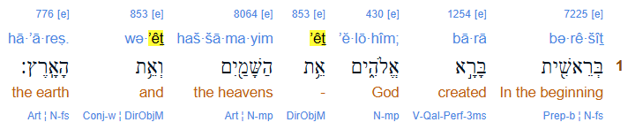
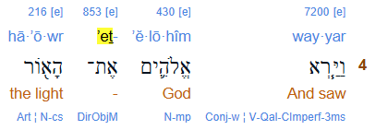
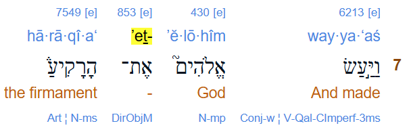
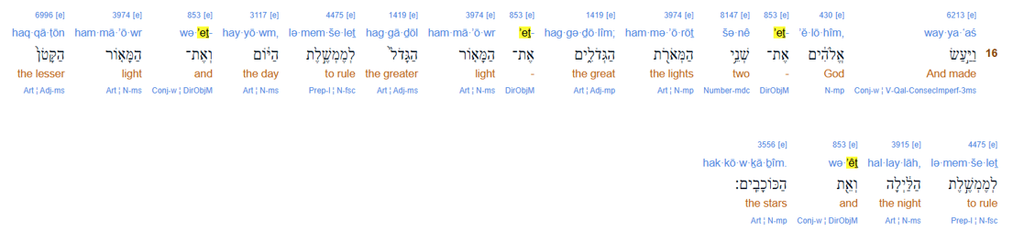
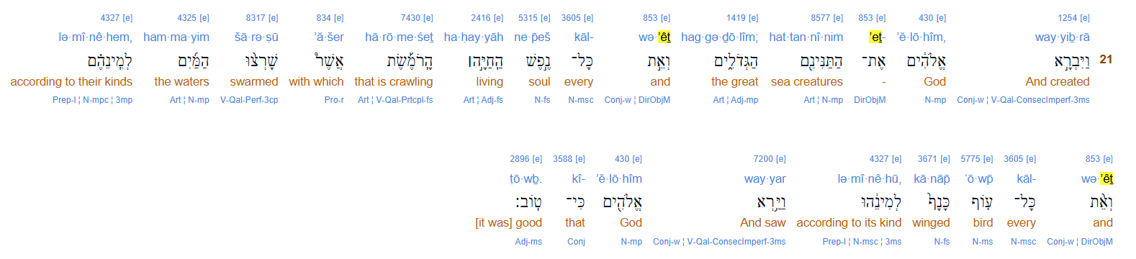


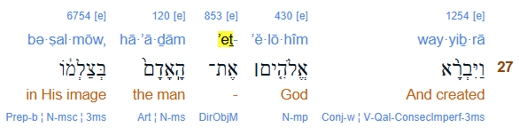

https://biblehub.com/interlinear/genesis/1.htm (Interlinear Bible © 2011 – 2013 by Biblos.com in cooperation with Helps Ministries, Section Headings Courtesy INT Bible© 2012, Used by Permission)
The Gospel of John 1 is Midrash of Genesis 1
I propose that John sees in Genesis God creating through the Alef–Taw: His own effective Word, carrying His wisdom and purpose into creation. From the beginning, God creates with Messiah in view. The heavens, earth, living creatures and humanity belong to a world intended for him and his inheritance. Knowing the outcome before He began, God orders creation toward the coming of this Son at the appointed time, and toward the glory He would receive through him. This messianic purpose guides His creative work throughout.
John calls that effective Word Logos and follows it through creation, life and light until it becomes flesh in Yeshua. In him, the purpose governing creation becomes a human life: God’s wisdom, character and saving intention are expressed through the Messiah’s words, actions and obedience. Yeshua reveals both the God whose Word he embodies and the goal toward which God’s wisdom had directed creation all along.
The following verse-by-verse commentary develops the central argument of this study. We will follow John’s movement through creation, life and light to Yeshua, in whom God’s purpose becomes a human life and the unseen God is made known.
| 1 In the beginning was the Word | John opens at creation, with God’s Word as his subject. Genesis repeatedly depicts God speaking reality into being; Psalm 33:6 explicitly names His word as the means of creation. Within the Alef–Taw reading proposed here, that creative Word carries the purpose governing the whole work, with Messiah already intended as its heir. John begins with what belongs to God before showing what it becomes in Yeshua. |
| and the Word was with God, | God’s purpose belongs with Him before it is accomplished: Job 23:14 describes things He has appointed as being “with Him,” while Proverbs 8:30 places Wisdom beside Him in creation. These provide a scriptural setting for John’s language, although they do not reproduce his exact Greek construction. The Word can therefore be understood as God’s own wisdom and intention accompanying His creative action. Messiah’s place within that purpose precedes his appearance in history. |
| and the Word was God. | John gives the Word the strongest possible identification: God. This reading understands that statement through God’s self-expression: the wisdom, will and power active in creation are His own. “With God” distinguishes the Word in the telling; “was God” prevents it from becoming something detached from Him. The question is whether John makes that distinction within God’s self-expression or between personal subjects; calling the Word God does not, by itself, settle that question. |
| 2 He was in the beginning with God; | John repeats the beginning because everything that follows belongs to the same account of the Word. Creation, life, light and flesh disclose the reach of what was already with God. On this reading, Messiah embodies the purpose with which God began, rather than a purpose devised only after creation failed. What appears later in history belongs to the intention governing the whole. |
| 3 all things were made through him, | Creation through the Word already has a scriptural explanation: God speaks, and what He commands comes to be (Psalm 33:6, 9). The Word is effective; it accomplishes creation rather than merely describing a future plan. In the proposed Alef–Taw reading, the heavens, creatures and humanity marked throughout Genesis belong to one creative undertaking. Colossians 1:16 supplies the wider messianic connection: creation comes through the Word and is directed toward the one in whom that Word becomes flesh. |
| and without him was not anything made that was made. | John makes the claim comprehensive: nothing created lies outside the activity of the Word. The Messiah’s significance consequently reaches beyond one nation or moment into the meaning of creation itself. Read alongside creation being “for him” in Colossians 1:16, the world becomes the inheritance God prepares with its intended heir in view. That is the larger synthesis proposed here; John’s immediate emphasis is the Word’s unrestricted creative scope. |
| 4 In him was life, | The Word contains the life it communicates. Psalm 36:9 locates the fountain of life with God, joining His life-giving presence to His light. John later explains that the Father grants the Son life in himself (5:26), preserving the relationship between the source and the one who communicates it. Within this reading, the life manifested in Messiah fulfills the life-giving purpose already active in creation. |
| and the life was the light of men. | John joins existence to understanding: the life within the Word becomes humanity’s light. Psalm 36:9 already connects these realities: life comes from God, and His light enables people to see. In Messiah, humanity encounters both the giver of life and the purpose toward which that life is directed. The movement is from being made alive to knowing the God who gives life. |
| 5 The light shines in the darkness, and the darkness has not overcome it. | Genesis places light before the sun, moon and stars; John develops light into the revelation that illuminates humanity. Within the proposed Alef–Taw reading, the light God sees in Genesis belongs to the creation pattern whose significance Yeshua discloses. The world can contain that light without recognizing what it reveals. This provides the connection with hidden-light traditions: presence precedes recognition, although John does not explicitly narrate the primordial light being concealed. |
| 9 The true light that enlightens every man was coming into the world. | The light’s reach is as wide as the humanity God created. Isaiah 49:6 supplies the messianic setting: God’s servant becomes light to the nations, extending His salvation beyond Israel. Yeshua brings that purpose into human experience, revealing the Creator to the people for whom His light shines. His significance is universal because the purpose embodied in him concerns the whole creation. |
| 10 He was in the world, and the world was made through him, yet the world knew him not. | The world made with him in view did not recognize him when he came. John places the Word’s role in creation beside the world’s failure to know its human embodiment. On this reading, Yeshua stands within the creation God prepared for him, yet its inhabitants do not recognize their intended heir or the purpose of their own existence revealed in him. |
| 14 And the Word became flesh and dwelt among us, | Here John states what the preceding account has been leading toward: the Word becomes flesh. The claim exceeds a prophet receiving a message; Yeshua embodies the effective Word through which God creates and makes Himself known. On this reading, the purpose guiding creation becomes a human life, and the witnesses recognize its glory in the Father’s unique Son. Knowing Yeshua gives them the perspective from which to understand what God had intended from the beginning. |
| 15 “…for he was before me.” | John appears first, but the Messiah is the reason for his mission. On this reading, “he was before me” expresses Yeshua’s priority in God’s purpose: the one announced was already central to the plan that called forth his herald. John prepares the way within a creation itself ordered toward Messiah. His testimony thus acknowledges the priority of God’s intended Son, whom I understand to precede John in foreordination rather than a conscious life before birth. |
| 18 No one has ever seen God; the only Son, who is in the bosom of the Father, he has made him known. | (Textual note: Greek manuscripts differ between monogenēs theos (“unique/only-begotten God”) and ho monogenēs huios (“the unique/only-begotten Son”). The RSV follows the “Son” reading; modern critical Greek editions print the “God” reading. “Only-begotten” versus “unique” concerns the translation of monogenēs; “God” versus “Son” is a manuscript difference. The distinction matters because the “God” reading explicitly applies that designation to the one who reveals the Father.) The Prologue reaches its goal in the revelation of the unseen God. Yeshua makes the Father known as the human embodiment of His effective Word, revealing His character and the purpose governing creation. If “God” is original, the designation must retain its force: John applies it to the revealer himself. I understand this through the Prologue’s opening identification: the Word was God, and that Word became flesh. Yeshua makes God personally known because he embodies God’s own self-expression; the Father whom he reveals remains his God (John 20:17). |
Notice two things. First, John begins with “the Word.” He does not begin with “Jesus” or “the Son.” Those identifications emerge as the Prologue unfolds. His choice of starting point matters.
Second, I propose that John reads the Alef–Taw pattern as expressing God’s complete determination: His unseen wisdom and intention becoming ordered reality.
Follow the proposed connection:
Alef–Taw → Logos at the beginning → everything comes through it → in it is Life → that Life is Light → Light shines → the true Light enters the world unrecognized → the Word becomes flesh → Yeshua is named → the unseen God is revealed.
John’s creation language invites comparison with the light preceding the sun, moon and stars. His account of light present yet unrecognized also invites comparison with Jewish hidden-light traditions. I bring these themes together in the reading that follows; John himself does not describe God concealing the first day’s light.
The Hidden Light & Messiah Named Before Creation
The following sections consider Jewish traditions of primordial light and a Messiah named or hidden before his appearance, asking where they illuminate John and where the comparison reaches its limits.
Consider the related imagery in the Second Temple Jewish work 1 Enoch 48:2–7:
“And at that hour that Son of Man was named, in the presence of the Lord of Spirits, and his name brought to the Head of Days. 3. Even before the Sun and the constellations were created, before the Stars of Heaven were made, his name was named in front of the Lord of Spirits. 4. He will be a staff to the righteous and the Holy, so that they may lean on him and not fall, and he will be the Light of the Nations, and he will be the hope of those who grieve in their hearts. 5. All those who dwell upon the dry ground will fall down and worship in front of him, and they will bless, and praise, and celebrate with psalms, the name of the Lord of Spirits. 6. And because of this he was chosen, and hidden in front of Him, before the World was created, and forever. 7. But the wisdom of the Lord of Spirits has revealed him to the Holy and the righteous, for he has kept safe the lot of the righteous, for they have hated and rejected this world of iniquity. And all its works and its ways they have hated in the name of the Lord of Spirits. For in His name they are saved and he is the one who will require their lives. *Note that this portion of 1 Enoch only survives in 5th or later century Ge’ez of the Ethiopian bibles.
My purpose is not to persuade you that 1 Enoch is inspired Scripture. Its value here is as a witness to Jewish interpretation.
It demonstrates that within Second Temple Judaism the Son of Man/Messianic figure could be spoken of as named before the luminaries, chosen and hidden before creation, and destined to become light to the nations, without the passage explicitly narrating his conscious life before birth.
Consider this comparison:
| Genesis 1 | 1 Enoch 48 | John 1 |
| In the beginning | Before sun and stars | In the beginning |
| God | Lord of Spirits | God |
| Divine creative action | Messiah already named | Logos already present |
| Primordial Light | Messiah will be Light | Life is Light |
| Light appears before luminaries | Messiah named before luminaries | Light precedes the world’s recognition of it |
| Creation ordered by God | Messiah chosen for a purpose | Everything comes into being through Logos |
| — | Messiah hidden | Light present but unrecognized |
| — | Wisdom reveals him | Logos becomes flesh |
| Humanity appears | Son of Man awaits his role | Yeshua appears as Son of Man |
Suddenly John’s language has a completely Jewish framework. John does not need to invent a second divine person. The Messiah could already be: named, chosen, loved, hidden, purposed, destined, and assigned an inheritance before he ever appeared historically.
The Gospel was proclaimed in an imperial world already saturated with claims about divine rulers, sons of gods, saviors, lords, benefactors, imperial peace, divine births, apotheosis, and “good news.” Christian proclamation necessarily entered that contested symbolic environment, and language about Yeshua could function polemically against Caesar even when its primary roots remained Jewish and scriptural.
John is not taking a Roman or Greek divine-man story and making Yeshua fit inside it. He is dragging the reader all the way back to Genesis and saying:
You want to know where Yeshua came from? Not Rome. Not Olympus. Not Caesar. Not a new god beside the God of Israel. Go back to Bereshit. Go back to the Word. Go back to the Light. Go back to the hidden Messiah. Then understand what happened: The Word became flesh.
Is a Messiah “named,” “chosen,” and “hidden” before creation personally alive before creation or present beforehand in divine purpose?
Israel’s Sages Witness to Foreordination, Not Pre-existence
The comparison between Genesis 1, 1 Enoch 48 and John 1 becomes richer alongside the reflections of Israel’s sages. Across Second Temple Jewish literature and later rabbinic tradition, we encounter recurring meditations on the Messiah’s name, his spirit, the hidden light and God’s purposes before creation. Their dates and relationships remain debated; my purpose is to trace the breadth and persistence of these themes, through which creation and redemption are repeatedly brought together.
“Six things preceded the creation of the world. Some of them were created, and some arose in thought to be created. The Torah and the Throne of Glory were created. …The patriarchs, Israel, the Temple, and the name of the Messiah arose in thought to be created. …From where do we learn this concerning the name of the Messiah? For it is said: “May his name endure forever; before the sun, Yinnon is his name.” Genesis Rabbah 1:4
Here the distinction is explicit: some things were created beforehand; others arose in God’s thought to be created. The Messiah’s name belongs to the second category. This supplies an actual interpretive precedent for priority in God’s purpose without prior personal life.
“Rabbi Elazar said: With the light that the Holy One, blessed be he, created on the first day, a person could see from one end of the world to the other. When the Holy One, blessed be he, looked upon the generation of the Flood and the generation of the Dispersion, and saw that their deeds were corrupt, he concealed it from them, as it is said: “Their light is withheld from the wicked.” For whom did he conceal it? For the righteous in the future to come, as it is said: “God saw the light, that it was good”; and “good” refers to the righteous, as it is said: “Say of the righteous that it is good.”” Talmud Bavli, Hagigah 12a
“Rabbi Yehuda son of Rabbi Simon said: “He separated it for himself.” The rabbis said: “He set it apart for the righteous in the future to come.” A parable: A king had a fine portion and set it aside for his son.” Genesis Rabbah 3:6
“Rabbi Shimon ben Yehotzadak asked Rabbi Shmuel bar Nahman: “Because I have heard that you are a master of aggadah, tell me: From where was the light created?” He replied: “It teaches that the Holy One, blessed be he, wrapped himself in it like a garment, and the radiance of his splendor shone from one end of the world to the other.” He told him this in a whisper. He said to him: “It is an explicit verse—‘He wraps himself in light like a garment’—and you tell it to me in a whisper?” He replied: “Just as I heard it in a whisper, so I have told it to you in a whisper.” Genesis Rabbah 3:4 Note: I understand the whisper as an allusion to the hidden light.
“What is the light for which the congregation of Israel waits? This is the light of the Messiah, as it is said: “God saw the light, that it was good.” This teaches that the Holy One, blessed be he, foresaw the Messiah and his deeds before the world was created, and stored it away for his Messiah, for his generation, beneath his Throne of Glory. Satan said before the Holy One, blessed be he: “Master of the world, the light concealed beneath your Throne of Glory—for whom is it?” He answered him: “For the one who will turn you back and put you to shame.”” Pesikta Rabbati 36:1
“The Messiah is called by seven names. These are: Yinnon, Our Righteousness, Branch, Comforter, David, Shiloh, and Elijah. From where is Yinnon derived? As it is said: “May his name endure forever; before the sun, Yinnon is his name.”” Rav Huna, Midrash Mishlei 19:3
The Prophetic Witness of the Hidden Light & Name
Now let us examine the Scriptures these sources cite.
“Give the king [knowledge of] Your [way of] judging, O God, and [the spirit of] Your righteousness to the king’s son [to control all his actions]. 2 Let him judge and govern Your people with righteousness, and Your poor and afflicted ones with judgment and justice. 12 “For He delivers the needy when he calls out, the poor also and him who has no helper. 13 He will have pity on the poor and weak and needy and will save the lives of the needy. 14 He will redeem their lives from oppression and fraud and violence, and precious and costly shall their blood be in His sight.”17 “His name shall endure forever; His name shall continue as long as the sun [indeed, His name continues before the sun]. And men shall be blessed and bless themselves by Him; all nations shall call Him blessed!” Psalm 72:1–2, 12–14, 17 Amplified Bible Classic Edition
The psalm’s enduring king is characterized by justice, protection of the vulnerable, and blessing extending among the nations. The rabbinic reading of verse 17 adds the perspective of a name appointed before the sun.
“Listen to me, O isles and coastlands, and hearken, you peoples from afar. The Lord has called me from the womb; from the body of my mother He has named my name. 2 And He has made my mouth like a sharp sword; in the shadow of His hand has He hid me and made me a polished arrow; in His quiver has He kept me close and concealed me. 3 And [the Lord] said to me, You are My servant, Israel [you who strive with God and with men and prevail], in whom I will be glorified.”6 “He says, It is too light a thing that you should be My servant to raise up the tribes of Jacob and to restore the survivors [of the judgments] of Israel; I will also give you for a light to the nations, that My salvation may extend to the end of the earth. 7 Thus says the Lord, the Redeemer of Israel, Israel’s Holy One, to him whom man rejects and despises, to him whom the nations abhor, to the servant of rulers: Kings shall see you and arise; princes, and they shall prostrate themselves, because of the Lord, Who is faithful, the Holy One of Israel, Who has chosen you.” Isaiah 49:1–3, 6–7 Amplified Bible Classic Edition
Notice: The Servant is called Israel, yet also has a mission to restore Israel. The naming is prenatal.
“16 I have put my words in your mouth, and covered you in the shadow of my hand, in order to plant the heavens, to found the earth, and to say to Zion, “You are my people.”” Isaiah 51:16 CSB
The connection with Isaiah 49:2 is especially strong: mouth/words + the shadow of God’s hand + concealment or protection. Isaiah 51:16 then adds the language of establishing heaven and earth.
“But you, O Bethlehem Eph′rathah, who are little to be among the clans of Judah, from you shall come forth for me one who is to be ruler in Israel, whose origin is from of old, from ancient days.” Micah 5:2 RSV
Rashi explicitly connects the ancient ruler to Yinnon:
““From you shall come forth for me”: the Messiah, son of David. …“Whose origins are from of old”: “Before the sun, Yinnon is his name.”” Micah 5:1 with Rashi
The Two Stories of Yeshua
One story moves downward and then upward. The other moves forward through Israel’s prophetic story toward resurrection and new creation. These are not simply two answers about Yeshua.
They are two theological architectures.
| The Later Council Driven Model: Begins with the personally pre-existent eternal Son. He exists in heaven. He descends. He becomes incarnate through the virgin conception. He is fully God and fully man. His Sonship is eternal. His authority ultimately belongs to him because of who he is by nature. He dies. He rises. He returns to heavenly glory. The movement is principally: Heaven → Incarnation → Death → Resurrection → Heavenly Glory. The defining transformation is incarnation. The eternal Son becomes man. | The Jewish-messianic model begins differently: Yeshua is foreknown within Yehovah’s redemptive purpose. He arises within Israel as the promised son of David. God anoints him with His Spirit. God works through him. He faithfully obeys. He dies. God raises him. God transforms him into immortal life. He becomes Firstfruits of the resurrection and Firstborn from the Dead. God exalts him. God appoints him judge. God gives him authority and Kingdom. The movement becomes: Promise → Israel → Anointing → Faithfulness → Death → Resurrection → Exaltation → New Creation → Kingdom. The defining transformation is resurrection. The mortal Messiah becomes immortal. |
Why One Story Feels Familiar
If the first story sounds like Christianity itself while the second initially sounds unfamiliar or even heretical, that difference cannot be attributed to Scripture alone. For many centuries, the Trinitarian interpretation has supplied the governing vocabulary of Christian institutions, creeds, theological education and ministerial recognition. Its categories became the normal language through which the biblical texts were taught, translated and organized.
This historical dominance does not prove that Trinitarianism is false. Neither does the unfamiliarity of the Jewish-messianic model prove that it is a modern invention. It means that the two interpretations have not reached most readers under equal conditions. One normally arrives already identified as Christian orthodoxy; the other must first overcome the suspicion created by departing from that inherited framework.
The pressure to interpret and practice faith within a dominant culture did not begin with Christian councils. Earlier Jewish encounters with Hellenistic power show how sharply the struggle could affect covenant identity, worship and communal survival. Nearly two centuries before Philo, 1 Maccabees described both voluntary Jewish accommodation to Greek culture and the subsequent attempt to eradicate Israel’s covenant practices by force:
1 Maccabees 1:11-15 and 41-50: “11 In those days lawless men came forth from Israel, and misled many, saying, “Let us go and make a covenant with the Gentiles round about us, for since we separated from them many evils have come upon us.” 12 This proposal pleased them, 13 and some of the people eagerly went to the king. He authorized them to observe the ordinances of the Gentiles. 14 So they built a gymnasium in Jerusalem, according to Gentile custom, 15 and removed the marks of circumcision, and abandoned the holy covenant. They joined with the Gentiles and sold themselves to do evil.”
“41 Then the king wrote to his whole kingdom that all should be one people, 42 and that each should give up his customs. 43 All the Gentiles accepted the command of the king. Many even from Israel gladly adopted his religion; they sacrificed to idols and profaned the sabbath. 44 And the king sent letters by messengers to Jerusalem and the cities of Judah; he directed them to follow customs strange to the land, 45 to forbid burnt offerings and sacrifices and drink offerings in the sanctuary, to profane sabbaths and feasts, 46 to defile the sanctuary and the priests, 47 to build altars and sacred precincts and shrines for idols, to sacrifice swine and unclean animals, 48 and to leave their sons uncircumcised. They were to make themselves abominable by everything unclean and profane, 49 so that they should forget the law and change all the ordinances. 50 “And whoever does not obey the command of the king shall die.” (RSV)
Jewish responses to Greek culture were never uniform. Some sought accommodation, some resisted it, and others adopted Greek language and intellectual methods while remaining committed to Torah. The importance of this history is that Hellenism was never merely an innocent exchange of vocabulary. It offered access to the dominant culture, but it could also exert enormous pressure upon Jewish identity, worship and interpretation. By Philo’s time the political circumstances had changed, but Jewish engagement with the Greek-speaking world still carried questions of acceptance, exclusion and survival.
Philo’s Alexandria supplies another example of the dangers Jewish communities faced within the Greek-speaking imperial world. In 38 CE, the Roman prefect Flaccus declared the Jews foreigners, confined them to a small part of the city, plundered their homes and businesses, destroyed synagogues, and permitted images of Caligula to be installed in those that remained. Jews were beaten, tortured and killed. Philo witnessed this persecution and led an embassy to Caligula, whose demand for divine honors eventually threatened the Temple in Jerusalem itself. The conflict remained so severe that Claudius was still intervening in 41 CE. (Philo, Against Flaccus 45–75; Philo, Embassy to Gaius; Claudius’s Letter to the Alexandrians)
These episodes do not establish a direct line from Hellenistic persecution to Trinitarian doctrine. They establish why the conditions under which religious ideas gain acceptance deserve examination alongside the ideas themselves. In later Christian history, doctrinal boundaries likewise came to be maintained through more than persuasion. Conciliar definitions became ecclesiastical boundaries and, after Christianity acquired imperial power, those boundaries were sometimes enforced through deposition, exile, confiscation and civil penalties. Later Catholic and Protestant societies continued, in different forms and degrees, to punish or legally disadvantage people who denied the Trinity. The modern social consequences are usually less severe, but teachers, ministers and ordinary believers may still risk employment, credentials, community and reputation merely by reopening the question.
None of that can decide the meaning of John’s Gospel. It does explain why one interpretation can appear self-evident before its assumptions have been examined. The purpose of placing these stories side by side is therefore not to reverse the old exclusion and dismiss Trinitarians in return. It is to give the earlier Jewish-scriptural architecture an opportunity to be heard on the strength of its evidence.
The Two Gospels
Both proclaim Yeshua’s death, resurrection and return. Both speak of salvation, faith, Spirit and Kingdom. Yet those shared words can carry different accounts of who Yeshua is, what God accomplished through him, and what believers are being called to become.
Their centers of gravity differ.
| The Trinitarian Account | The Jewish-Messianic Account | |
| Who stands at the center? | The eternal Son who becomes human for our salvation. | The human Son for whom God’s purpose has prepared the world. |
| What does his obedience reveal? | How the incarnate Son lives a genuinely human life in obedience to the Father. | How God’s intended human life is fulfilled in the Messiah: faithful, dependent, and obedient to his God. |
| What does his resurrection mean? | The incarnate Son conquers death and rises in glorified humanity. | God raises His mortal Messiah into immortal life, the firstfruits of the resurrection others will share. |
| How is his exaltation understood? | The one who eternally shares the Father’s glory is exalted also as the risen man. | God grants His faithful Messiah the authority, glory and inheritance intended for him. |
| What are believers called into? | Communion with God through the incarnate Son, whose life they follow and whose resurrection they share. | Faithful participation in God’s purpose through His Messiah: obedience, resurrection, shared inheritance and Kingdom. |
The difference becomes especially clear when we ask what makes Yeshua’s life the foundation of our hope:
In the first account, the eternal Son enters our humanity to bring us into communion with God.
In the second, God brings His purpose for humanity to fulfillment in Yeshua and calls us to share that fulfillment with him.
The one for whom creation was intended becomes the firstfruits of what God intends for others.
On this reading, Yeshua’s dependence, obedience, resurrection and exaltation disclose the course of the life into which we are being called. His God is our God. His resurrection anticipates ours. His inheritance becomes an inheritance shared with his people. Israel’s restoration and the gathering of the nations belong to that same purpose.
Trinitarians also affirm discipleship, resurrection and shared glory. The distinction concerns the account that holds these promises together. Here, their unity lies in God’s purpose for His human Messiah, a purpose that embraces creation itself and draws a people into its fulfillment.
To confess this Messiah is to recognize the one in whom God’s purpose for us has already begun to be fulfilled and to answer the call to walk as he walked.
Two Ways of Explaining the Same Evidence
Classical Trinitarian orthodoxy depends upon a connected framework of claims:
- Personal pre-existence and eternal Sonship.
- Virgin conception and incarnation.
- Full deity and full humanity.
- Two natures united in one person.
- The Son sharing the same divine essence as the Father.
These commitments shape one another and how the biblical evidence is explained.
Remove eternal personal pre-existence, and incarnation must be reconsidered.
Remove incarnation, and the account of the eternal Son becoming human changes.
Remove full deity, and the two-natures formula loses its purpose.
Remove that formula, and the explanations of Yeshua’s ignorance, temptation, dependence, death and subordination must be rebuilt.
Consider why those explanations are needed:
Yeshua is tempted, yet the one undergoing temptation is understood to be God the Son.
He lacks knowledge, yet must also possess omniscience as God.
He receives authority, yet must also possess authority by nature.
He obeys God and is subordinate to Him, yet must remain His equal in deity.
He dies, yet his divine nature cannot die.
Trinitarian theology explains these tensions through distinctions concerning his person, natures and role. The question is whether Scripture requires the identification that makes those distinctions necessary.
The point is not that no explanations exist. The point is that the framework requires them.
The Jewish-messianic reading argued here understands these descriptions within a different account:
- Sonship: Yeshua is the promised Davidic king, whom God acknowledges as His Son.
- Anointing: He is Messiah because Yehovah anoints him.
- Power: God works miracles through him.
- Obedience: He submits his will to the Father’s will.
- Dependence: He relies upon God because God is his God.
- Temptation: He faces temptation and remains faithful.
- Knowledge: His knowledge has limits; he receives revelation from the Father.
- Authority: God grants him the authority he exercises.
- Death: He dies because he is mortal.
- Resurrection: God raises him into immortal life.
- Exaltation: God brings him into the glory and rule intended for His Messiah.
Together, these descriptions show how God brings His purpose to fulfillment through Yeshua: the Son obeys, God raises him, and the faithful Messiah receives his promised inheritance. His dependence, mortality and received authority belong to the very course by which God’s purpose is accomplished.
This explanatory strength deserves to be seen. Sonship, anointing, obedience, resurrection, exaltation, priesthood, inheritance and kingship already belong to Israel’s scriptural vocabulary. This reading brings them together around the Messiah in whom God’s purpose is fulfilled.
The continuity is between what God promised, what Yeshua lived, and what God accomplished by raising and exalting him.
One God, One Messiah, One Hope
The weight of generations does not place an interpretation beyond examination. Imperial endorsement, institutional authority, and inherited familiarity cannot do the work of scriptural evidence. Every framework must answer to the witness it claims to explain, including the framework presented here.
This article has argued for a coherent account of creation, promise, and fulfillment. God creates through His effective Word, with Messiah in view. His wisdom orders the world toward the Son who will inherit it. In Yeshua, that Word becomes flesh: God’s character and purpose become personally known through a faithful human life.
The meaning reaches into everything we believe and everything we are called to become:
- Creation has a purpose.
The Messiah belongs to God’s intention from the beginning, and through him others are welcomed into the inheritance God prepared.
- His obedience gives our calling its shape.
We follow the Messiah who trusted the God he reveals, learning his faithfulness, dependence, courage, and love.
- His resurrection gives our hope its substance.
The God who raised Yeshua has promised to raise those who belong to him. Death will surrender its hold.
- His exaltation gives history its direction.
God’s appointed king will bring His purpose to fulfillment, overcoming every enemy until God is all in all.
For those wearied by threats, exclusion, or the fear of asking an honest question, there is room to breathe. Conscience must be persuaded through truth. A restoration worthy of that name must welcome examination and practice the freedom it proclaims.
Our calling is to become a people whose lives make this hope visible: faithful to God, merciful toward others, steadfast in suffering, and courageous in witness. We carry that invitation among the nations while preparing for Messiah’s return.
Let us make that path straight.
Our Confession
Hear, O Israel: Yehovah our God, Yehovah is one.
We love Him with all our heart, with all our soul, and with all our strength.
His word is faithful. His covenant endures.
We confess Yeshua, His Messiah: foreknown before creation,
revealed among us, faithful unto death, raised to everlasting life,
exalted at God’s right hand.
His God is our God. His Father is our Father. His resurrection is our hope.
By God’s Spirit, we walk in His ways.
We pursue justice. We love mercy.
We love our neighbors. We bless our enemies.
We await Messiah’s return: Israel restored, the nations gathered,
the dead raised, and death defeated.
We will share his inheritance and serve his God forever.
One God. One Messiah. One hope.
May His Kingdom come. May His will be done. May all the earth be filled with His glory.
Amen.
Yehovah, our Father, let Your truth correct us,
Your mercy heal us, and Your Spirit make us faithful.
Make our lives a straight path toward You.
Gather the nations to Your light,
and prepare us as a spotless bride for Yeshua’s return.
Amen.